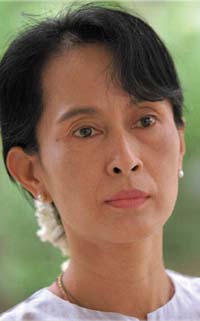
Showing posts with label Aung San Suu Kyi. Show all posts

Thursday, August 27, 2009

Myanmar opposition leader Aung San Suu Kyi to appeal

Yangon - Myanmar opposition leader Aung San Suu Kyi has agreed to appeal a recent court decision that put her under house detention for the next 18 months, her attorneys said Thursday.

"We will file the appeal to the Divisional Court for Daw [Madame] Aung San Suu Kyi on Monday or Tuesday next week," Nyan Win, one of Suu Kyi's three lawyers, said after meeting with the Nobel Peace Prize laureate to discuss her appeal.

Suu Kyi, 64, who has spent 14 of the past 20 years under detention, has also requested that authorities allow her personal doctor Tin Myo Win to be allowed to visit her regularly for check-ups as was permitted under the previous rules of her detention.

On August 11, a special court set up in Yangon's Insein Prison found Suu Kyi guilty of violating the terms of her house arrest and sentenced her to three years in prison. The sentence was quickly commuted to 18 months under house detention by Myanmar's military supremo, Senior General Than Shwe.

Suu Kyi was found guilty of allowing US national John William Yettaw to swim to her lakeside home-cum-prison on May 3, where he stayed uninvited until May 5, to warn her of an assassination attempt he had envisioned.

The bizarre escapade provided a pretext for Myanmar's military regime to accuse Suu Kyi of violating the terms of her detention and to keep her out of the political picture for the next 18 months while it prepares for a general election next year, which promises to be neither free nor fair.

Yettaw, 54, was sentenced to seven years in prison but was freed on August 16 at the request of visiting US Senator Jim Webb, chairman of the US Senate's East Asia and Pacific Affairs Subcommittee.

Webb, in a rare interview with Than Shwe, also requested that Suu Kyi be released but failed to secure the opposition leader's freedom.

Suu Kyi's ongoing house detention meant that it was unlikely that her National League for Democracy opposition party, which won the last polls in 1990 but has been denied power for the past 19 years, would participate in next year's election.

It also dashed hopes that prior to the polls, the regime might open a dialogue with the democracy icon and consider amending the 2008 constitution, which essentially cements the military's control over any democratically elected government.

Sunday, June 14, 2009

Suu Kyi trial adjourned till Jun 26

A young supporter of Myanmar's Pro-democracy leader Aung San Suu Kyi. Photo Courtesy: AP.

The trial of pro-democracy leader Aung San Suu Kyi was adjourned on Friday for two weeks so defence lawyers can call an additional witness who will testify that the case is politically motivated, a lawyer said.

The District Court trying Suu Kyi told lawyers of the postponement until June 26 during a brief hearing on Friday at Insein Prison, where the trial is taking place, said Nyan Win, one of Suu Kyi's attorneys.

Suu Kyi is charged with violating the terms of her house arrest when an uninvited American man swam secretly to her closely guarded lakeside home last month and stayed two days.

The hearing has drawn outrage from the international community and Suu Kyi's local supporters, who say the military government is using the bizarre incident as an excuse to keep the pro-democracy leader detained through next year's elections.

If convicted, the 63-year-old Nobel Peace laureate faces up to five years in prison. She has been detained under house arrest for more than 13 of the last 19 years.

It is widely expected that Suu Kyi will be found guilty because courts in Myanmar are known for handing out harsh sentences to political dissidents. No new date was immediately set for closing arguments, which were originally scheduled for June 1.

Friday's postponement was expected after Suu Kyi's lawyers won an appeal earlier this week to reinstate one defence witness - Khin Moe Moe, a lawyer and member of her National League for Democracy party.

"Daw Khin Moe Moe knows all the charges against Daw Aung San Suu Kyi are political and she would testify based on these facts," Nyan Win said. "Daw" is a term of respect.

Suu Kyi's lawyers have filed a second appeal with the High Court to bring back two other witnesses - both senior members of her opposition party.

The District Court trying Suu Kyi had initially rejected the three defence witnesses - leaving Suu Kyi with a sole witness.

All three would argue that Suu Kyi is not a threat to the "peace and tranquility of the state," said Nyan Win, citing the provision of the 1975 law authorities had used for her continued detention.

Suu Kyi told her lawyers she believes the case against her is "politically motivated" but that it wouldn't stop her from continuing her fight for democracy, Nyan Win said Thursday.

"She said she is engaged in politics due to her political belief and commitment," Nyan Win said. "She would not be doing politics if she were afraid of the consequences."

Suu Kyi's party won the country's last elections in 1990 but was not allowed to take power by the military, which has run the country since 1962.

Thursday, May 28, 2009

Burmese junta fears repeat of NLD's 1990 triumph

By Supalak Ganjanakhundee


The Burmese military junta is challenging the credibility of Thailand, Asean and the international community over the on-going trial of opposition leader, Aung San Suu Kyi, which might extend her detention for another five years.

Statement after statement from Thailand as chair of Asean, the United States, the European Union, the United Nations and the Asia-Europe Meeting calling for her immediate release were unlikely heard in Nay Pyi Taw and Rangoon.

Leaders and officials of many countries and regional groupings worked very hard to find words which could hit hard directly to the junta. They called on the generals to take responsibility as a member of the international community.

US President Barack Obama in his latest statement said Suu Kyi's continued detention, isolation and "show trial based on spurious charges" cast serious doubt on the Burmese government's willingness to be a responsible member of the international community.

Prime Minister Abhisit Vejjajiva as chairman of Asean, stressed clearly that with the eyes of the international community on Burma, the honour and credibility of its government were at stake.

The Asia-Europe Meeting's statement after a gathering of foreign ministers in Hanoi on Tuesday called for the early release of those under detention and the lifting of restrictions placed on political parties.

The Burmese junta reacted to these statements negatively and regarded them as interference in its domestic affairs. Perhaps the international community does not really exist in the junta's imagination. Sense of isolation is still strong among the generals whose military regime has run this country continuously for nearly half a century.

A counter statement from Burma's Foreign Ministry said Thailand, as the chair, had "failed to preserve the dignity of Asean, the dignity of Burma and the dignity of Thailand" since Bangkok had commented on a member's internal affairs.

The Burmese authorities continued the trial of Suu Kyi as usual. The presence of some foreign diplomats and journalists in the courtroom in the Insein prison was a single indicator that the international support existed, although the foreign attendance was on and off.

Many observers said the trial was a pretext to keep Aung San Suu Kyi, secretary-general of the National League for Democracy, away from the planned general election next year.

Lessons from the previous election nearly 20 years ago taught the junta that Aung San Suu Kyi's freedom is a grave danger to them. The military-backed National Unity Party won only 10 seats or about 2 per cent of the total 485 seats in the parliament while the NLD swallowed 392 seats in the 1990 election.

That is the reason why Aung San Suu Kyi has had to spend most of her time under house arrest since returning to her home country shortly before the 1988 uprising.

Her current term of house arrest since the bloodshed incident in May 2003 had already ended, on Wednesday 27 May, but Police Brigadier-General Myint Thein, head of the Police Special Branch said the term of Aung San Suu Kyi's house arrest could be legally extended for another six months, from now until November 27.

According to the police, the authorities considered releasing her, until the May 4 incident when American John Yettaw swam across the Inya Lake to her residence and spent overnight there with Aung San Suu Kyi's acknowledgement.

The junta charged her of breaching the authorities' "Law to Safeguard the State Against the Dangers of Those Desiring to Cause Subversive Acts" by accommodating the American. If convicted she might be punished with a maximum five years' imprisonment.

Asean and the international community needs to do more to get Aung San Suu Kyi released. Statements alone do not work.

Even sanctions imposed by the US and EU did not seriously hurt the junta, since trade and investment from neighbouring countries like Thailand and China helped release the pressure.

Burmese Citizens are Angry, but Silent

By KYAW ZWA MOE

The trial of Aung San Suu Kyi has gripped the hearts of the Burmese people because they respect and love her. Rationally, however, they know they can have little affect on the junta’s show trial now unfolding in Insein Prison.

A prominent writer in Rangoon summed it up in a phone conversation with The Irrawaddy on Wednesday: “The trial has made people feel helpless and even more hopeless.”

There are three factors that account for the lack of even modest public protests by ordinary citizens and political activists—economic hardship, harsh military oppression and lack of opposition leadership.

The people know the trial of the pro-democracy leader is rigged, and that she will soon be sentenced to up to five years in prison. They’re angry, but their anger is suppressed, boiling but contained—they can’t afford to let it overcome their daily struggle to survive and provide for their families.

Win Tin, a prominent member of Suu Kyi’s National League for Democracy (NLD), the main opposition party, said: “People are angry, but they are more concerned with their daily living.”

There’s no doubt that many people are unwilling to openly show their support for Suu Kyi because of the junta’s well-known willingness to use violence against citizens, which creates real, understandable fear. Images of the bloody crackdown on the monk-led protests in 2007 are still fresh in people’s minds.

“The trial has made people harbor more hatred towards the generals than ever,” the writer said, speaking on condition of anonymity. “On the other hand, they are more frightened.”

For Burma, the political tide turned on May 14 when Suu Kyi was transferred from her home to Insein Prison and charged with violating the terms of her house arrest after an eccentric American intruder swam across Inya Lake and illegally entered her compound, where he remained for two days.

A lack of leadership within the political opposition has been a topic of concern. About 2,100 political prisoners, including many potential leaders, are in jail.

Sein Win, an outspoken and well-known Rangoon journalist, told The Irrawaddy on Wednesday, “The leading political party is weak.”

Even so, the ailing, respected journalist said he still believes in the people: “Our people are as courageous as ever since the era of the independence struggle,” in the early 20th Century.

On Wednesday, the NLD held its 19th anniversary of the election in which it won by a landslide, only to see the junta not honor the results, and it issued a strong statement calling for the release of its leader, Suu Kyi.

Since the trial began last week, the junta has beefed up security around Insein Prison and infiltrated members of Sawn Arr Shin, a junta-backed paramilitary group, among Suu Kyi’s supporters, who maintain a vigil outside the gates.

One supporter at the prison said, “They provoke us. One of them deliberately uttered a provocative remark: “‘Why are you guys coming to see the wife of a kalar?’” referring to Suu Kyi’s marriage to a British citizen. In Burmese, kalar is a vulgar term that refers to an Indian and Western people. The supporter said, “We have to hold back our anger.”

While anger is suppressed inside the country, the uproar within the international community is louder than ever.

“It is time for the Burmese government to drop all charges against Aung San Suu Kyi and unconditionally release her and her fellow political prisoners,” US President Barack Obama said on Tuesday. “Aung San Suu Kyi has represented profound patriotism, sacrifice and the vision of a democratic and prosperous Burma.”

The international community, including the European Union and the United Nations Security Council, has all expressed their concerns about Suu Kyi’s trial. Even members of the Association of Southeast Asian Nations have been more outspoken than ever against the junta.

However, seasoned observers are skeptical that the international community will take further steps beyond expressing concern. Again, the ruling generals are experts at gauging international reaction and moving ahead with disdain, ever tightening their grip on power while nullifying the moves of the opposition.

The international community’s competing policies of economic sanctions versus constructive engagement have both had little impact on the junta’s hold on power or influenced its movement toward democratic reconciliation.

Both critics and dissents are also saddened that mounting pressure from the international community will likely have no affect on the trial’s verdict or sentence. After attending the trial last week, British Ambassador to Burma Mark Canning summed it up, “I think this is a story where the conclusion is already scripted. I don’t have confidence in the outcome.”

What wasn’t scripted was the spontaneous sign of respect by international diplomats last week and on Tuesday, who rose to their feet when Suu Kyi walked into the courtroom. The gesture spoke louder than words.
Monday, May 25, 2009

Ethinic Minorities Draw Inspiration from Aung San Suu Kyi


Active ImageBurmese ethnic minorities, including the Chin, Karenni, and Shan, look to Aung San Suu Kyi to lead a call for national reconciliation within Burma.
Below is an article published by Mizzama :

Expressing concern for democracy icon Daw Aung San Suu Kyi, currently facing trial in Rangoon’s Insein prison, Burma’s ethnic nationalities have said that they look at her as a turning point for national reconciliation in the country.

Duwa Mahkaw Hkunsa, General Secretary of the Ethnic Nationalities Council-Union of Burma (ENC), in exile said, the Nobel Peace Laureate had won their hearts and trust and hoped that she could unite the various ethnics of Burma into a federal union.

“We believe, she can lead the process of national reconciliation and also build a federal union, which we, the ethnics have been demanding,” said Hkunsa.

Earlier, ethnic leaders have had opportunities to discuss with Aung San Suu Kyi, during her short periods of freedom from house arrests, and have spoken of issues, including the building of a federal union, he said.

“She has also promised the ethnic leaders of wanting to build such an union,” Hkunsa added.

The ENC was first established in 2001, as Ethnic Nationalities Solidarity and Cooperation Committee (ENSCC), with an objective of bringing together different ethnics and also to advocate for a tripartite dialogue, as the solution for Burma’s political crisis.

Later, it was transformed into the Council in 2004 and was renamed as the Ethnic Nationalities Council. The ENC was later re-structured and was made into a state-based organization, representing the existing states of Burma – Arakan, Chin, Karen, Karenni (Kayah), Mon and Shan.

Hkunsa said, the ENC is concerned over the current trial that Aung San Suu Kyi is facing and has called the charges against her, mere pretexts to continue detaining her.

“We already know that the junta will do something to her before her detention period ends, because they do not want to see her out before the 2010 elections,” Hkunsa said, adding that Aung San Suu Kyi continues to pose a threat to the junta, as she is well loved and is popular among the people.

“People love her, including soldiers and back her, so the authority are afraid and simply wants to continue detaining her,” he said.

Meanwhile, the Karen National Union (KNU), one of the longest running armed resistance groups in Burma, also expressed their concern over the trial against Aung San Suu Kyi.

Naw Zipporah Sein, General Secretary of the KNU, told Mizzima, she is concerned about Aung San Suu Kyi and believes that she is the only person, who can lead a tripartite dialogue, in the process of national reconciliation.

“She means a lot of hope for all of us and as a leader, she has proved her ability to work with all ethnics,” Naw Zipporah Sein said.

Meanwhile, without Aung San Suu Kyi, it is almost hopeless to talk about a tripartite dialogue, which is being demanded by all ethnic groups, the KNU leader said.

Condemning the current trial of Aung San Suu Kyi, Naw Zipporah Sein, called on the United Nations Security Council to intervene and stop the junta from detaining her further.

“We oppose this trial. It is simply unjust, the international community must pressurize the junta to release her,” Naw Zipporah Sein said.


Thursday, May 21, 2009

Protest And Hunger Strike Demanding Aung San Suu Kyi’s Release

By Van Biak Thang
Chinland Guardian
19 May, 2009

More than 200 people yesterday joined a 'heated-up' demonstration in front of Burmese Embassy in London, as part of a global day of action for Aung San Suu Kyi, whose 'illegal' trial has drawn into a second day in Rangoon's notorious Insein Prison after being charged with breaching security laws following an intrusion by the American swimmer into her lakeside residence.

The protesters, angered by the brutal and inhumane behaviours of SPDC, demanded the immediate release of Burma's pro-democracy leader Daw Aung San Suu Kyi along with other political prisoners, shouting slogans including 'Free innocent Aung San Suu Kyi, right now'.

Anna Roberts, Director of Burma Campaign UK, told Chinland Guardian: “Today, there has been a fantastic turnout demonstrating in front of the Burmese Embassy in London. It shows that how angry people are at what the regime has done, arresting Aung San Suu Kyi on trumped-up charges and trying to keep her in detention."

"Clearly, the regime wants to make sure that Aung San Suu Kyi and all voices that represent are squashed before their sham election in 2010 next year. What was very clear from the demonstration today is that people want to see the international communities take actions and to see the United Nations, the EU and Burma's neighbours translate what they have said 'they are concerned about Aung San Suu Kyi' into actions.”

London-based Burmese Embassy was closed on the day with a placard reading ‘Today, Embassy is temporarily closed. Sorry for the inconvenience’. The London Police had to block the street as it was filled up with protesters including mothers with babies.

Benedict Rogers, East Asia Team Leader of Christian Solidarity Worldwide UK, told Chinland Guardian: "Today is a very important demonstration and an important expression of outrage, anger, and disgust at the decision by the regime to put Aung San Suu Kyi in Insein prison and to come up with full charges. And I think all of us here are expressing that outrage. We need to see Daw Aung San Suu Kyi as representative of the sufferings in the whole of Burma and it is absolutely right that we focus on her plights today and in the immediate future because her situation is very grave and dangerous and she is such an important person for all of Burma but we also need to remember the sufferings of the peoples of Burma. And until all the people of Burma can be free, we will not stay silent."

"We hope that the leaders of this world - of the UN, of the EU, of China and ASEAN - will also hear their consciences and will stop working with this regime and stop tolerating what they are doing, and actually take action to free Aung San Suu Kyi and to bring an end to the suffering of the people of Burma," continued Ben Rogers, highlighting in his message the famous speech of Martin Luther King saying ‘stand up for truth, righteousness and justice’.

Other key speakers included representatives from National League for Democracy (Liberated Area, UK), Women of Burma UK, Burma Muslin Association, Karen National Union, Kachin National Organisation, Chin Community, Arakan Rohingya National Organisation, Wai Hnin Pwint Thon (daughter of political prisoner Mya Aye), Burma Democratic Concern, human rights activists and other Burmese organisations.

Miss Dim Lian, on behalf of the Chin in the UK, told the protesters: "The Chin people are also deeply saddened by the awakening of this horrendous news. Shocking as it is, but I hope this may not come to you all as a surprise, as we are immune to the Burmese authority's inhumane and relentless behaviours.”

“Burma is a country known for its brutal regime's atrocities against its own people mainly on three accounts: ethnicity, politics and religion. The charge against Daw Aung San Suu Kyi is the most visible manifestation of the regime's atrocity and brutality. She is a woman who sacrifices her freedom for the freedom of Burmese people. We, the Chin people, pray that God will sustain her, comfort her and keep her in peace in this most difficult time,” she added.

After the demonstration, a group of Burmese protesters started a 24-hour hunger strike to show their solidarity with Aung San Suu Kyi and other political prisoners.

A multi-faith prayer service, where Buddhists, Muslims, Christians and non-believers gathered in unity, was last Sunday held at a Buddhist monastery in Colindale, North London. A Chin pastor, who wants to remain unnamed, attended the service, representing the Chin and Burmese Christians in the UK.

The global day of action for Aung San Suu Kyi took place in more than 20 cities around the world, calling on world’s leaders and the international communities to take action on Burma and to free Aung San Suu Kyi, whose terms of detention is officially expiring late this month.

Wednesday, May 20, 2009

Myanmar Opens Suu Kyi Trial to Media

YANGON, Myanmar – Myanmar's military regime unexpectedly opened pro-democracy leader Aung San Suu Kyi's trial to reporters Wednesday and allowed diplomats to meet her – rare concessions in the face of world-wide outrage over the handling of her case.
Army-ruled Myanmar opened the prison trial of pro-democracy leader Aung San Suu Kyi to a limited number of diplomats and journalists.
The Nobel Peace laureate, who has been in detention without trial for more than 13 of the past 19 years, is accused of violating the terms of her house arrest after an American man stayed at her home without official permission. The offense is punishable by up to five years' imprisonment.
She is standing trial with two female members of her party who live with her, and John W. Yettaw, the American who swam to Ms. Suu Kyi's lakeside home under the cover of darkness earlier this month and sneaked in uninvited.
Ms. Suu Kyi, appearing alert and in good spirits, greeted diplomats and told them she hoped they could meet again "in better times," according to two diplomats who asked not to be identified because they were not authorized to speak to the press.
The trial adjourned Wednesday after two more police officers testified for the prosecution, including one who interviewed Ms. Suu Kyi after her arrest. He said Ms. Suu Kyi told him that she provided Mr. Yettaw with rehydration salts and several meals.
A township police officer also presented 23 items of evidence, including two black cloaks that resembled abayas typically found in Saudi Arabia, which Mr. Yettaw allegedly left behind for Ms. Suu Kyi. Two women modeled the all-black garb in the courtroom.

Ms. Suu Kyi, who is being held at the infamous Insein Prison along with scores of other political prisoners, had been scheduled to be freed May 27 after six consecutive years under house arrest. The charges against her are widely seen as a pretext for her to stay in detention during polls scheduled for next year –the culmination of the junta's "roadmap to democracy," which has been criticized as a fig leaf for continued military rule.
Myanmar has been under military rule since 1962. It last held an election in 1990, but the junta refused to honor the results after a landslide victory by Ms. Suu Kyi's National League for Democracy party.
The court on Monday rejected a request by Ms. Suu Kyi's lawyer for an open trial.
But on Wednesday, the country's Information Ministry ruled that five foreign correspondents and five local reporters could attend the trial's afternoon session. Authorities also said all embassies could send one diplomat.
A U.S. consular official had been allowed to attend the court sessions because Mr. Yettaw is standing trial, but the proceedings were otherwise closed to the press and public.
At the same time, authorities have agreed to allow the Thai, Singapore and Russian ambassadors to meet with Ms. Suu Kyi at the conclusion of her trial on Wednesday, said a diplomat, who asked not to be identified because he was not authorized to speak to the press. They are expected to meet her in a "guest house" within the prison compound where she is being held.
The move comes a day after the Association of Southeast Asian Nations expressed "grave concern" about developments related to Ms. Suu Kyi and reaffirmed calls for her immediate release. It also called for her to get adequate medical care and be treated with dignity.
"With the eyes of the international community on Myanmar at present, the honor and the credibility of the government of the Union of Myanmar are at stake," ASEAN said in a statement.
The comments were unusually tough for an organization that normally refrains from criticizing its member countries.
U.S. State Department spokesman Ian Kelly said the charges against Ms. Suu Kyi were "unjustified" and called for her unconditional release and that of more than 2,100 other political prisoners.
Ms. Suu Kyi's arrest could well derail a "softer" approach that the Obama administration had been searching for to replace sanctions and other get-tough policies that have done nothing to divert the junta's iron-fisted rule.
China, which as Myanmar's closest ally probably has the most influence with its ruling generals, has shown no sign it is exerting pressure on Myanmar's government.
"Myanmar's issue should be decided by the Myanmar people," Foreign Ministry spokesman Ma Zhaoxu said at a regular news briefing. "We hope that the relevant parties in Myanmar could realize reconciliation, stability and development through dialogue."
Hundreds of police in full riot gear, some armed with rifles, were deployed along all roads leading to Insein prison where the trial was taking place, while Ms. Suu Kyi supporters gathered peacefully nearby.
Two photographers working for Japanese media were detained Wednesday by authorities for 20 minutes after they took shots of diplomat's cars entering the prison, witnesses said. They were released after showing proof they were foreign correspondents.
The family of 53-year-old Mr. Yettaw, of Falcon Missouri, describes him as a well-intentioned admirer of Ms. Suu Kyi who merely wanted to interview her, unaware of the possible consequences. Ms. Suu Kyi's supporters have expressed anger at him for getting her into trouble.

Monday, May 18, 2009

Myanmar's Suu Kyi defiant ahead of trial - lawyer

YANGON - Myanmar's pro-democracy icon Aung San Suu Kyi is in good health and ready to defend herself against new charges that have triggered international condemnation of the military regime, her lawyer said.

Kyi Win, Suu Kyi's main defence lawyer at her trial due to start on Monday, was allowed to meet the Nobel Peace laureate for one hour at a guest house in Yangon's Insein Prison on Saturday.

"She asked me to tell her friends and everyone that she is quite well," Kyi Win told Reuters. "She is ready to tell the truth that she never broke the law."

The 63-year-old Suu Kyi is charged with breaking the conditions of her nearly six-year house arrest after an American intruder sneaked inside her lakeside villa in Yangon this month.

If convicted, she faces up to five years in jail.

Suu Kyi's two female companions have also been charged in a case denounced by critics as a pretext for keeping the charismatic opposition leader in detention ahead of elections in 2010. Her current detention expires on May 27.

Suu Kyi's National League for Democracy (NLD) won a landslide election victory in 1990 only to be denied power by the military, which has ruled the former Burma since 1962.

The generals have detained Suu Kyi for more than 13 of the past 19 years, mostly at her home on a leafy Yangon avenue guarded by police, her phone line cut and visitors restricted.

Suu Kyi's doctor, Tin Myo Win, was freed late on Saturday after he was detained on May 7 for questioning, relatives said. Suu Kyi was recently treated for low blood pressure and dehydration, and activists fear for her health in prison.

Rights groups also slammed the junta on Saturday for revoking the law licence of Aung Thein, a prominent activist lawyer who was to be on Suu Kyi's defence team.

The Thailand-based Assistance Association for Political Prisoners (AAPP) called it "a blatant attempt by the regime to damage the defence for Daw Aung San Suu Kyi and her two live-in party members".

MYSTERY SWIMMER

Kyi Win said Suu Kyi was innocent because she did not invite John Yettaw, who according to state media swam across Yangon's Inya Lake to her home using homemade flippers earlier this month.

"She told me that they found him at the back of her house at about 5 a.m. She told him to leave, but he refused saying he was exhausted," Kyi Win said.

Suu Kyi did not report him to authorities because "she did not want anybody to get into trouble because of her", he said.

Yettaw, described by state media as a 53-year-old psychology student from Missouri, has been charged with "illegal swimming", immigration violations and encouraging others to break the law.

Kyi Win said Yettaw had tried a similar stunt to meet Suu Kyi in November 2008, but she refused to speak to him and the incident was reported to authorities.

Yettaw's motives remain unclear, but speculation about his role in the junta's latest crackdown on Suu Kyi has swirled for days in the streets of Yangon.

"I think the regime must be behind this incident one way or another. They do not want to free Daw Suu," a retired politician, using the Burmese honorific for older women, said.

The junta has so far ignored the international outcry over what critics say are "trumped up" and "baseless" charges against Suu Kyi.

U.S. President Barack Obama renewed sanctions against the regime on Friday, saying its actions and policies, including the jailing of more than 2,000 political prisoners, continued to pose a serious threat to U.S. interests.

Washington has led the West in tightening sanctions, but Asian neighbours with an eye on the country's rich timber, gas and mineral reserves have favoured a policy of engagement.

Neither has succeeded in coaxing meaningful reforms from junta leader Senior General Than Shwe, who is widely believed to loathe Suu Kyi.

He has vowed to press ahead with a seven-step "roadmap to democracy" expected to culminate in 2010 elections which the West derides as a sham to entrench the military's grip on the country.

Saturday, May 16, 2009

Myanmar: Ethnic Minorities & Aung San Suu Kyi

By Lee Jay Walker
Tokyo Correspondent


Aung San Suu Kyi
The current regime in Myanmar is clearly unconcerned about international opinion because daily persecution continues. This applies to the continuing persecution of many minorities, notably the Chin, Karen, Rohingya, Shan, and others. At the same time, the leading political figure in Myanmar, Aung San Suu Kyi, faces further confinement. However, the regime fears little because of power politics and geopolitical factors.
Another major concern in Myanmar is the systematic persecution of religious minorities and this especially applies to Christians and Muslims. Therefore, the Christian dominated Karen National Union (KNU) faces a joint military and Buddhist onslaught because the Democratic Karen Buddhist Army (DKBA) is a staunch ally of the regime.
Other Christian and Muslim minorities also face daily persecution. Therefore, like I reported in my last article called
"Karen Christians face joint army and Buddhist onslaught," I will quote Benedict Rogers who is a human rights advocate and journalist.
Because Benedict Rogers (12 Dec, 2004) notified the British House of Commons about systematic persecution. He stated that "Christians among the Chin, Kachin, Karen and Karenni ethnic nationalities report serious religious discrimination and persecution, including the destruction of churches and Christian symbols. In Chin State, all crosses on mountain-tops have been destroyed and Christians have been forced to build Buddhist pagodas in their place. Church services have been disrupted, and Chin children from Christian families have been taken and placed in Buddhist monasteries, where they have been forced to become novice monks. The printing of the Bible is banned, and Christians in government service are denied promotion."
Muslims are also in dire straights because they have been persecuted for decades. Amnesty International, for example stated that "The Rohingyas’ freedom of movement is severely restricted and the vast majority of them have effectively been denied Burma (Myanmar) citizenship. They are also subjected to various forms of extortion and arbitrary taxation; land confiscation; forced eviction and house destruction ... "

The report continues that "In 1978 over 200,000 Rohingyas fled to Bangladesh, following the ‘Nagamin’ (‘Dragon King’) operation of the Burma (Myanmar) army. Officially this campaign aimed at "scrutinising each individual living in the state, designating citizens and foreigners in accordance with the law and taking actions against foreigners who have filtered into the country illegally." This military campaign directly targeted civilians, and resulted in widespread killings, rape and destruction of mosques and further religious persecution."

"During 1991-92 a new wave of over a quarter of a million Rohingyas fled to Bangladesh. They reported widespread forced labour, as well as summary executions, torture, and rape. Rohingyas were forced to work without pay by the Burma (Myanmar) army on infrastructure and economic projects, often under harsh conditions. Many other human rights violations occurred in the context of forced labour of Rohingya civilians by the security forces."

Therefore, many ethnic and religious minorities have been persecuted for decades and this is the real tragedy of Myanmar. After all, it would appear that regional nations are more concerned about economic trade and maintaining a regional consensus.

Yes, from time to time you hear disenting voices throughout the region but these are few and far. Also, for regional powers like China and India, they both understand the geopolitical importance of Myanmar and of course economic interests are also important. So it would appear that ethnic and religious minorities have little hope under the current political system in Myanmar.

Meanwhile, the most famous political figure in Myanmar faces fresh political charges in order to keep her under house arrest. However, Aung San Suu Kyi remains defiant despite her endless persecution and the “ray of hope remains.”

Aung San Suu Kyi once stated that “It is not power that corrupts but fear. Fear of losing power corrupts those who wield it and fear of the scourge of power corrupts those who are subject to it.”

Yet for the people who wield power in Myanmar, it is apparent that China and India, and others, are willing to play the geopolitical game. Therefore, despite the European Union and America taking a strong stance, it is clear that Myanmar can survive because of trading links with China, India, Singapore, South Korea, Thailand, and other nations.

Also, Aung San Suu Kyi understands that only an internal collapse or uprising will change the current status quo. Despite this, she remains loyal to non-violent action and “her weapon” is her firm democratic conviction.

However, just like the ethnic Christian and Muslim minorities, and others, it is clear that decades of struggle is zapping the energy out of many; so words of strength by Aung San Suu Kyi are badly needed. Yet the chains appear to be getting tighter so the future remains bleak.

Friday, May 15, 2009

Clinton to Raise Suu Kyi’s Case Worldwide

By LALIT K JHA

WASHINGTON — US Secretary of State Hillary Clinton says she will raise the imprisonment of Burmese opposition leader Aung San Suu Kyi with the UN, Burma’s partners within the Association of Southeast Asian Nations (Asean)—and even China.

Describing the removal of Suu Kyi from her home to Rangoon’s infamous Insein Prison as unlawful and “a pretext to place further unjustified restrictions on her,” Clinton told a press conference in Washington on Thursday that she would also raise the democracy icon’s plight with UN Secretary-General Ban Ki-moon.

Clinton was speaking after meeting visiting Malaysian Foreign Minister YB Datuk Anifah bin Haji Aman, who promised to raise the matter with the Asean Secretariat and also seek a solution through the Asean+3 group, which includes China.

Clinton said: “We are reaching out to our Asean partners like Malaysia. I hope to be speaking myself to the [UN] Secretary-General. We think that this does rise to the level of the kind of regional statements of concern that we would ask for.

“We will also raise this with other nations like China and see if we can’t, on a humanitarian basis, seek relief for Aung San Suu Kyi from this latest effort to intimidate and perhaps even incarcerate her.”

The Malaysian Foreign Minister said the arrest of Suu Kyi made it all the more important not to isolate Burma. “We do not want to leave Myanmar in isolation,” he said.

“We will use the good office of the Asean Secretariat to immediately engage in and to finding solutions to this matter, and if it is possible, this—the Asean+3, which includes China—we would also be, if it’s necessary to engage in, to seek their views and assistance in trying to solve the problem.”

Clinton said she was deeply troubled by the decision by the Burmese regime to charge Suu Kyi with a baseless crime. “It comes just before the six-year anniversary of her house arrest, and it is not in keeping with the rule of law, the Asean charter, or efforts to promote national reconciliation and progress in Burma.

“We oppose the regime’s efforts to use this incident as a pretext to place further unjustified restrictions on her, and therefore we call on the Burmese authorities to release her immediately and unconditionally, along with her doctor and the more than 2,100 political prisoners currently being held.”

Thursday, May 14, 2009

Australia calls for release of Suu Kyi

By Sandra O'Malley

Australia has called for the immediate release of pro-democracy leader Aung San Suu Kyi after Burmese authorities sent her to prison over an unauthorised visit by an American.

The 63-year-old, who has lately been in poor health, has been under house arrest for the past two decades.

She was sent to the notorious Insein prison on Thursday after being charged over an incident in which an American man swam across a lake to visit her house.

Foreign Minister Stephen Smith expressed grave concern over the latest chapter in Ms Suu Kyi's incarceration.

"It is Australia's longstanding position - shared by governments of both political persuasions - that she should be released immediately and unconditionally and I repeat that today," he told parliament.

Ms Suu Kyi has spent most of the past 19 years detained in virtual isolation in her crumbling compound since the Burmese military junta refused to recognise her National League for Democracy's landslide victory in the country's last elections in 1990.

Opposition foreign affairs spokeswoman Julie Bishop told parliament the military junta had ignored the will of the majority of Burmese people.

Ms Bishop travelled to Burma in 1995 and met Ms Suu Kyi.

Ms Suu Kyi said at the time that she was "a prisoner in her own country".

She said it seemed "the Burmese regime is determined to make that a reality".

The junta was "unparalleled" for its human rights abuses against Burmese people.

"The world must engage in greater levels of diplomacy and other actions to ensure that Aung San Suu Kyi is freed and that freedom and democracy is returned to the people of Burma," Ms Bishop said.

Saturday, May 9, 2009

Burma's Suu Kyi 'in poor health'

Burma's detained pro-democracy leader Aung San Suu Kyi (file photo)
Ms Suu Kyi's latest detention is due to expire at the end of May
Burma's detained opposition leader Aung San Suu Kyi is suffering from low blood pressure and dehydration and is barely eating, her party spokesman says.

Nyan Win said they were extremely worried about the 63-year-old Nobel Laureate's health.

A medical assistant has placed Ms Suu Kyi on an intravenous drip. Her own doctor was reportedly detained after visiting her earlier this week.
Ms Suu Kyi She has been under almost permanent house arrest since 1990.

It followed the victory of her National League for Democracy (NLD) in a general election in 1990. The junta has refused to allow the party to assume power.

Ms Suu Kyi's latest period of detention is due to expire at the end of May but the authorities have not yet said if it will be extended.

Break-in
"We are very concerned about her health and security conditions," Nyan Win of the NLD told the BBC.

He said Ms Suu Kyi had suffered a loss of appetite and had gone three to four days without eating.

As a result, her blood pressure had dropped and she was showing symptoms of dehydration.

Burmese opposition leader Aung San Suu Kyi's house in Rangoon, Burma (file image)
An intruder broke into Ms Suu Kyi's off-limits compound a week ago
Nyan Win said the party was closely monitoring the situation, and would decide next week whether to press for greater medical treatment for Ms Suu Kyi.

Nyan Win said it was not clear why physician Tin Myo Win had been arrested last Thursday.

He speculated that it could be linked to the arrest on Tuesday of a man carrying a US passport who swam across a lake to the property.

About 20 police are reported to have entered Ms Suu Kyi's house on Thursday morning.

It followed reports that an American, identified as John William Yeattaw, had managed to breach tight security to swim across Inya Lake and enter Ms Suu Kyi's house secretly on Sunday.

He was arrested after swimming back across the lake late on Tuesday.

Such an incident would be the first time someone has broken into Ms Suu Kyi's compound.

Thursday, May 7, 2009

Myanmar arrests US citizen for visiting Aung San Suu Kyi

Yangon, May 7: A US citizen arrested while swimming in a Yangon lake is under investigation for having spent three nights at the compound of detained opposition leader Aung San Suu Kyi, Myanmar's state media reported Thursday.

John William Yeattaw, 53, was arrested at 5.30 a.m. Wednesday at Inya Lake, which rims Suu Kyi's family home, where she has been kept under house arrest for the past six years.

Yeattaw arrived in Yangon Saturday and managed to enter Suu Kyi's compound Sunday night, where he secretly stayed until swimming away early Wednesday, the government mouthpiece New Light of Myanmar newspaper reported.

Authorities found in Yeattaw's bag a flashlight, a camera, pliers and $100 in cash plus kyat currency notes.

"The government is investigating what Yeattaw's intention was in entering a prohibited area," the newspaper said.

Suu Kyi's compound is under heavy guard and constant surveillance. She was last arrested May 27, 2003, and has been kept under house arrest in near-complete isolation.

The Nobel Peace Prize laureate has spent 13 of the past 19 years under detention in her family's Yangon compound.

Suu Kyi is the daughter of Aung San, an independence hero who was assassinated in 1948. She returned to Myanmar in 1988 to tend to her ailing mother and became caught up in the country's nascent pro-democracy movement, of which she swiftly became a leading figure.

Wednesday, March 25, 2009

Detention of Aung San Suu Kyi in Burma illegal, says UN

UN calls for immediate release of Aung San Suu Kyi


The United Nations has ruled that the continued detention of Burma’s pro-democracy leader Aung San Suu Kyi violates the country’s own laws as well as those of the international community.
Suu Kyi, a Nobel Peace Prize laureate, has spent 13 of the last 19 years under house arrest, with the ruling junta yearly extending her detention despite international outcries.
“The latest renewal (2008) of the order to place Ms Suu Kyi under house arrest not only violates international law but also national domestic laws of Myanmar,” said a legal opinion by the UN Working Group on Arbitrary Detentions that has been sent to the Burmese government.
Although the ruling is unlikely to spring Suu Kyi from detention, it is uncommon for the world body to accuse a member country of violating its own laws, and while the junta has always marched to its own tune it has also resented being regarded as an international pariah.
The working group, an arm of the UN Human Rights Council, said Suu Kyi was being held under Burma’s 1975 State Protection Law, which allows renewable arrest orders for a maximum of only five years. This five-year period ended at the end of May 2008.
The opinion also questioned whether Suu Kyi represented a threat to the “security of the state or public peace and tranquility,” the provision of the 1975 law authorities have pointed to as the reason for her continued detention.
Jared Genser, a Washington-based attorney retained by Suu Kyi’s family who provided the document to the Associated Press, said that while the UN group earlier found her detention arbitrary and in violation of international law, it was the first time it cited the junta as failing to abide by its own law.
He said the government of Burma has not responded to the UN’s legal arguments and has not commented on why Suu Kyi is still being detained.
Suu Kyi, who rose to prominence during a pro-democracy uprising in 1988, was placed under arrest before her party swept the 1990 general elections, which the junta did not recognise. Over the years, the government released her several times only to have her virtually isolated again in her compound in Yangon.
The UN has for years attempted without success to bring about political reform and a dialogue between Suu Kyi and the military.
“I am under no illusion that the junta will be listening to the UN,” Genser said in a telephone interview. “There is no quick and easy answer to the problem of Burma, so we have to take it one step forward at a time.”
In Burma, the spokesman for Suu Kyi’s National League for Democracy, Nyan Win, said over the weekend that her lawyer had sent a letter to the prime minister, Thein Sein, on 13 March asking for a hearing to appeal for her release when the one-year detention period expires in May.
The lawyer, Kyi Win, sent the appeal letter last October but has had no response from authorities, the spokesman said.
“The reason for her detention is false because Daw Aung San Suu Kyi, who advocates a nonviolence policy, has not caused any threat to public order,” he said.
Nyan Win said every time Suu Kyi’s detention is extended, authorities read out the order “but no explanation or reason was ever given for the extension or detention”.
Asked if Suu Kyi’s detention might be lifted in May, Nyan Win said, “It is very difficult to make any predictions as the government does not have a transparent policy.”
Activist groups, under a Free Burma’s Political Prisoners Now Campaign, are attempting to collect 888,888 signatures for a petition calling for the release of Suu Kyi and more than 2,100 other political prisoners.
The petition is to be sent to UN Secretary-General Ban Ki-moon. The number “8” is regarded as highly auspicious by many Burmese.
Burma has been under military rule since 1962. Its leaders have scheduled elections next year that they say will lead to democracy. Critics say the balloting, held under a junta-orchestrated constitution, will merely perpetuate military control.